Battle Ropes
One Rope. More Exercise Options Than You'd Expect.
When I first saw a battle rope I genuinely wasn't sure how you'd get a decent workout from a single rope. Then I did five 30-second rounds of all-out up and down waves. It was one of the most intense and enjoyable upper body workouts I'd ever done. Every muscle in my body fired, especially my arms and shoulders. I now use the battle rope as a conditioning tool as part of my regular upper body training.
Battle rope training is genuinely an all-in-one strength and cardio workout.
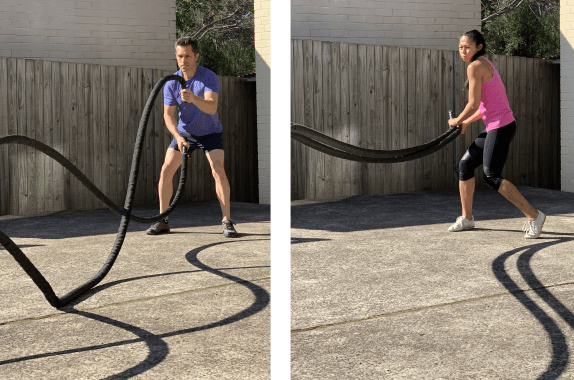
What makes battle ropes worth having?
Upper body focused conditioning
Most high-intensity exercises focus on the lower body through running and jumping. The battle rope is unique because it primarily uses the upper body driven by the arms and shoulders, while still engaging your entire body through core stabilisation. If you want to develop upper body conditioning and endurance alongside strength, battle ropes are one of the best tools available.
Low injury risk
Because it's a non-impact exercise system, the injury risk is minimal. You're not loading joints under heavy weight or creating impact through jumping. You're simply generating waves with a rope, which is as low risk as conditioning exercise gets.
Corrects imbalances
When you perform up and down waves you'll likely notice that your dominant side creates bigger, more coordinated waves. Over time as you train consistently, both sides strengthen and even out. It's a natural imbalance correction tool built into the exercise.
What size rope should you get?
Battle ropes come in various lengths and thicknesses. Standard sizes are 9 metres, 12 metres or 15 metres in length and 38mm or 50mm thick. The longer and thicker the rope, the heavier and more challenging it is.
I use and recommend a 15 metre by 38mm rope. If it's too challenging when you first use it, wrap it around the anchor point a few times to shorten the effective length. As you get stronger and fitter, unwrap it to increase the challenge. This gives you a single rope that serves you at multiple fitness levels without needing to buy a different rope as you progress.
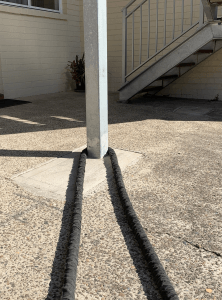
How to set up the rope
Anchor your rope to a solid structure or wrap it securely around a stable post. Never attach it to anything moveable. Once anchored, make sure each end of the rope is equal in length and you're ready to start.
Grip position
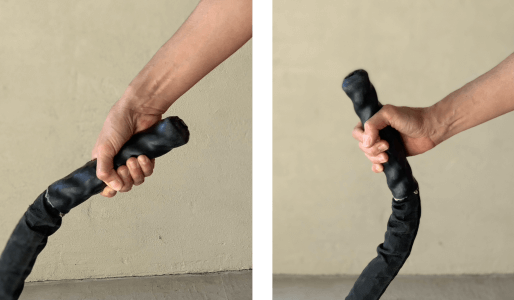
There are two main grip positions when using battle ropes.
|
Overhand |
Underhand |
Overhand grip
Palms facing down toward the floor. This is the most common starting grip and the one used for the up and down wave. It emphasises the forearms, biceps and shoulders.
Underhand grip
Palms facing upward toward the ceiling. This shifts the emphasis slightly and changes the muscle activation pattern. Experiment with both grips across different exercises to develop the full range of upper body conditioning the ropes offer.
Getting started: your starting position
Grab both ends of the rope in each hand and hold the rope with tension. Take a big step forward toward the anchor point to create a little slack and place your feet shoulder-width apart.
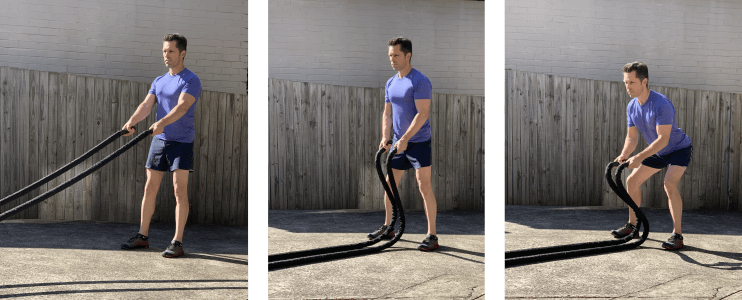
Hip-hinge and sit back on your hips while engaging your core and maintaining a straight back. This strong position helps you maintain balance and prevents the rope from pulling you forward during exercises. This is your starting position for most battle rope exercises.
Your first exercise: up and down waves
From your starting position, hold the rope with an overhand grip and move your arms alternately up and down, creating waves that travel the full length of the rope to the anchor point.
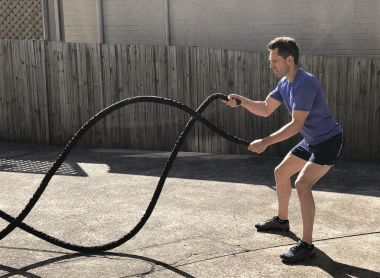
Aim for even, smooth waves of equal size on both sides.
Keep your wrists, arms and shoulders nice and relaxed throughout. Smooth, controlled waves are more effective than tight, jerky ones. Master your technique first, then progress to other exercises and greater intensity.
Start with 5 rounds of 30 seconds with 30 seconds rest between rounds. That's enough to show you exactly what battle ropes are capable of.
Learn to relax
When I was a competitive sprinter, one of the most valuable lessons my coach taught me was to relax under tension. I remember him telling me I needed to relax when sprinting at top speed. Counterintuitive as it sounds, relaxing allowed me to maintain top speed for a longer distance without tightening up. My times improved significantly as a result.
The same principle applies directly to battle rope training. When you don't grip the rope too tightly and keep your wrists, arms and shoulders relaxed throughout the movement, you can maintain speed and intensity for significantly longer before fatigue sets in. Tension kills efficiency. Relaxation preserves it.
This is a skill that takes a little practice but once you feel the difference between tense and relaxed rope waves, you'll never go back to gripping hard.
Health should feel like your best life, not a break from it.
Marco ☕
 |
About Me I'm Marco Asnicar, personal trainer, nutrition coach and founder of Vitality Marco. I didn't discover the Mediterranean method. I grew up living it, shaped by Italian roots, real food and movement as a natural part of daily life. I coach men and women aged 35 to 55 to do the same. No restriction. No fads. No giving up the life you love. Just a way of eating and living that genuinely feels good and gets better every year. Want to know more about my story and approach? Read my full About Me page → |