The Eating Pattern That Finally Matched How My Brain Works
My energy used to rise and fall with what I ate and when. Once I matched my eating pattern to how my brain actually works, everything changed.
I used to think my energy was just unreliable. Some days I was sharp, clear and unstoppable. Other days I was flat by mid-morning, pushing through fog until the afternoon. I wasn't eating badly. I was eating the wrong things at the wrong times. Once I finally saw that pattern, everything else started to make sense.
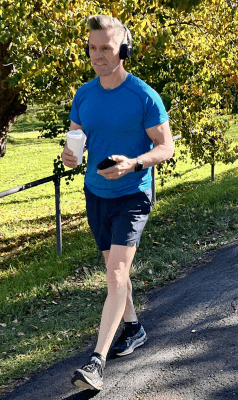
It took me years to see it clearly. My energy was never random. It rose and fell directly with what I ate and when I ate it. Once I understood that, I stopped eating the way I'd been told to eat and started eating the way my body was actually asking me to.
I never get tired now. I very rarely get sick. I fall asleep easily, sleep well and wake up ready to go. I haven't restarted an eating plan in decades, because I've never needed to. What I have done is pay close attention to how I felt, keep what worked, adjust what didn't, and let the whole thing evolve gradually into something that fits me so precisely it barely feels like a plan at all. It feels like me.
The goal was never to find the perfect plan. It was to understand my own body so well that the right way of eating found me. That's exactly what happened over the last decade.
Here's exactly what I eat, when I eat it, and why I think food timing has been the single most important shift I've ever made.
My brain has always worked differently
I've known since I was young that I wasn't wired quite the same way as the people around me. I had extraordinary focus when something genuinely engaged me, and almost no capacity to sustain attention when it didn't. Structured environments that most people navigated comfortably felt like wearing the wrong size shoes all day. I did my clearest thinking while moving, alone, without anyone waiting on me to perform.
I found repetitive work genuinely painful. I avoided conflict because emotional intensity was overwhelming in a way I couldn't always explain. And my best ideas never came at a desk. They came on walks, in the shower, somewhere between the first and second coffee of the morning.
For a long time I filed all of this under quirks and got on with it. But looking back, almost every habit I've built around food, movement and lifestyle has been my brain quietly engineering the conditions it needs to function at its best. I just didn't have the language for it until recently.
If any of that sounds familiar, keep reading. This eating pattern might make more sense to you than anything you've tried before.
The most effective lifestyle isn't the one with the best plan. It's the one that fits the way your brain actually works.
Why food timing changed everything for me
Most eating advice is built around a fairly standard assumption. Eat breakfast, eat lunch, eat dinner, spread your food through the day, keep your metabolism going. For a lot of people that works reasonably well. For my brain, it was the wrong pattern entirely.
When I ate a heavy breakfast, my energy dipped by mid-morning. When I ate lunch, my afternoon thinking became sluggish and slow. I wasn't overeating. I was eating at the wrong times for how my brain was running.
Here's what I eventually worked out. The brain has natural peaks and troughs in cognitive performance across the day. For me, that peak is in the morning. It's when my thinking is fastest, my creativity is sharpest and my capacity for deep, original work is at its highest. Heavy food during that window costs me that peak. Digestion draws blood flow and energy toward the gut and away from the brain. The mental clarity I had an hour ago disappears behind a wall of post-meal flatness.
Once I understood this, I stopped eating against my own body and started eating with it. The up and down energy that had followed me for years simply resolved.
My energy was never random. It rose and fell directly with what I ate and when I ate it. Once I matched my eating to my body's natural rhythm, the pattern finally made sense.
Mornings: protect the peak
I keep mornings light. Not as a discipline practice. As a genuine preference, because it's when I feel best.
I start with two flat whites (coffee with milk) made on my stainless steel Bialetti stovetop percolator. Freshly ground medium roast beans from my local roaster, fine grind, purified water, heated milk. I sip them slowly over about four hours. Some mornings I'll grab a coffee at a favourite café while on a walk. I don't rush the coffee. It's one of the true pleasures of my morning and I treat it accordingly.
Caffeine is genuinely useful for a brain wired like mine. It increases dopamine availability, which is the neurotransmitter behind focus, motivation and the feeling of reward. But I don't spike it. I let it build slowly, which means sustained clarity rather than a sharp lift followed by a crash.
In between I eat fresh seasonal fruit, almost always including bananas, and drink water. On weekends I might make scrambled eggs with mushrooms, vegetables and a couple of slices of sourdough toast. But even then it's relaxed and light. The point is to stay nourished without burdening digestion during the hours when my brain is doing its best work.
This is when I think, write, create and plan. I guard this window carefully because once it's gone, it doesn't come back in the same way later in the day.
Light mornings aren't about eating less. They're about protecting the cognitive state you naturally wake up with.
The fast I didn't know I was doing
I don't eat my first substantial meal until after 3pm. This means I'm fasting and eating light for somewhere between 12 and 16 hours after dinner the night before, depending on when I ate. I started doing this intentionally in 2016 after reading The Longevity Diet by Dr Valter Longo, whose research on fasting and longevity I find genuinely compelling. But if I'm honest, my body had been pushing me toward this pattern for years before I had a name for it. I simply wasn't hungry in the mornings or through late morning. I was energised, not hungry.
What I now understand is that the fasted state actually supports the kind of cognitive performance my brain craves in the morning. Fasting has been shown to increase sensitivity to dopamine, which means the brain responds more effectively to the focus and motivation signals it's already producing. My clearest thinking happens when I'm moving, lightly caffeinated and in a fasted state. That combination, for my brain, is as close to optimal as it gets.
By early to mid-afternoon, that morning peak has naturally eased. That's when I eat my first real meal, and it lands at exactly the right moment. My body is genuinely hungry. My brain has done its best work and is ready to shift gears. The meal feels earned and satisfying in a way that a forced 7am breakfast never did.
My brain was already telling me when to eat. I just needed to start listening.
Afternoon: my first real meal, after 3pm
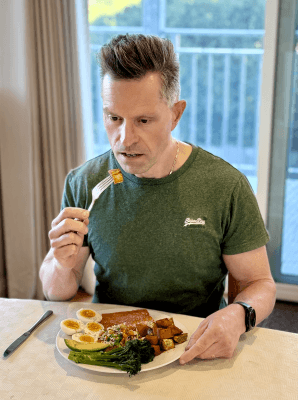
My afternoon meal is always Mediterranean-style. Lean protein, starchy carbohydrates and a generous raw salad with plenty of fresh vegetables. Real food, cooked simply, eaten with genuine enjoyment.
The protein keeps me satiated and supports the muscle I've worked to build. The starchy carbohydrates give me sustained energy through the afternoon without spiking my blood sugar. The raw salad brings fibre, phytonutrients and that particular freshness that I've come to love as a non-negotiable part of how I eat.
I sit with this meal. I don't rush it. It's the centrepiece of my eating day, and it deserves that treatment.
Evening: winding a busy brain down
Here's the part of this pattern that I found most surprising when I finally understood the science behind it.
My evening meal is lighter than my afternoon meal, but it’s deliberately higher in starchy carbohydrates. Not because I was following a protocol, but because this is what my body told me it needed at night, and I listened.
Some nights that means a protein source with potatoes, rice and cooked vegetables, finished with a small dessert. Other nights I skip the savoury plate altogether and have something bigger and dessert-style instead: sourdough toast with nut butter and fresh fruit, yoghurt with protein powder and homemade granola, or sometimes just a bowl of seasonal fruit. Either way, dessert is always part of the meal, because I always eat dessert after dinner. Not as a reward for good behaviour. As a genuine pleasure built into how I live.
What the science says about this is fascinating. Starchy carbohydrates in the evening increase serotonin production, and serotonin converts naturally to melatonin, the hormone that initiates sleep. Eating carbs at night is essentially using food as a natural wind-down signal for the brain.
For a brain that runs fast and can resist slowing down, this matters enormously. About two hours after dinner I start feeling genuinely sleepy. Not groggy or forced. Just naturally ready for bed. I fall asleep easily, sleep deeply and wake up the next morning clear and ready. The cycle begins again.
For a brain that finds it hard to decelerate, evening starchy carbohydrates aren't a dietary compromise. They're one of the most effective natural sleep tools I've found.
The pattern as a whole
Mornings: light, slow, protected
Two flat whites sipped over four hours. Fresh seasonal fruit and water in between. Occasionally scrambled eggs and sourdough on weekends. No heavy food. No rush. My brain does its best work here and I've learned to protect that.
Through to afternoon: light and focused
No lunch. No snacking. Genuinely not hungry, genuinely clear. The light state, the slow coffee, the light movement — these combine into the most productive cognitive state I know.
After 3pm: my first real meal
Mediterranean-style. Lean protein, starchy carbohydrates, raw salad. Eaten slowly, with enjoyment, at exactly the moment my body is ready for it.
Evening: carbs, something sweet, natural sleep
Lighter food, higher in starchy carbohydrates. Always something sweet to finish. Asleep naturally within two to three hours.
The never tired, never sick part
People notice this about me and ask what I'm doing. I take no pharmaceuticals. I haven't spent a day in hospital. I rarely get so much as a cold.
I don't think this is luck. I think it's the compounding result of nearly a decade of eating in a way that genuinely supports my immune system, my sleep quality, my stress levels and my energy, all at once, without any of them working against each other. When your lifestyle supports your biology instead of fighting it, your body stops spending energy managing damage and starts using that energy to stay genuinely well.
But more than the health outcomes, what this eating pattern gives me is a brain that works the way it's supposed to. Sharp when I need it to be sharp. Calm when it's time to rest. Consistent in a way that used to feel completely out of reach.
I arrived at all of this intuitively, through years of quiet honest attention to how I felt. There was no single moment of revelation. Just a decade of small adjustments, gradual fine-tuning, and the willingness to keep listening to my body even when the advice I was reading pointed somewhere else. The neuroscience simply confirmed what my body had been telling me all along.
If your energy has always felt tied to what you eat and when, if mornings are when you think best and heavy food early leaves you flat, if rigid eating plans have always felt like wearing someone else's clothes, this pattern might be worth exploring. Not as a protocol to adopt precisely. As a starting point to test honestly against your own experience, keep what works, adjust what doesn't, and let it evolve into something that fits you rather than something you're forever trying to fit into.
That's exactly how I found it. And it took the best part of a decade to get it right. Which means it's actually yours to build, not mine to hand you.
For more on the Mediterranean approach behind this pattern, the free guides on the homepage are a good place to start. And Marco's Mediterranean Method is built around exactly this kind of intuitive, enjoyable and sustainable way of eating.
Explore the free guides on the homepage →
Start Marco's Mediterranean Method →
Health should feel like your best life, not a break from it.
Marco ☕
 |
About Me I'm Marco Asnicar, personal trainer, nutrition coach and founder of Vitality Marco. I didn't discover the Mediterranean method. I grew up living it, shaped by Italian roots, real food and movement as a natural part of daily life. I coach men and women aged 35 to 55 to do the same. No restriction. No fads. No giving up the life you love. Just a way of eating and living that genuinely feels good and gets better every year. Want to know more about my story and approach? Read my full About Me page → |