Exercise Ball
Build Core Strength, Balance and Stability on an Unstable Surface
The exercise ball, also known as a stability ball, fit ball, Swiss ball, gym ball or Physioball, is a versatile piece of equipment used for core strengthening, aerobics, stretching, Pilates, yoga and rehabilitation exercises.
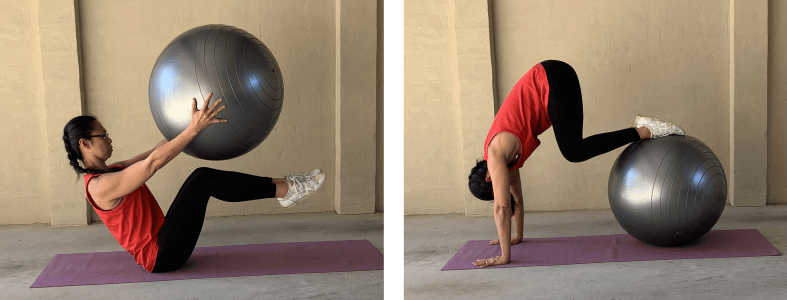
I use the ball primarily for ab and core strengthening exercises and for increasing the difficulty of specific resistance exercises by introducing an unstable surface. When you perform exercises on an unstable base, your body has to recruit stabiliser muscles throughout the movement that would otherwise stay passive on a stable surface.
The benefits of exercise ball training
Improves core strength, stability and posture
Core muscles are the abdominal and back muscles that are crucial for proper posture and stabilising the body during everyday activities. Just sitting on an exercise ball will engage your core. Try sitting on one instead of a chair for 30 minutes with good upright posture and you'll feel it in your stomach muscles the next day. That's your core working to keep you stable.
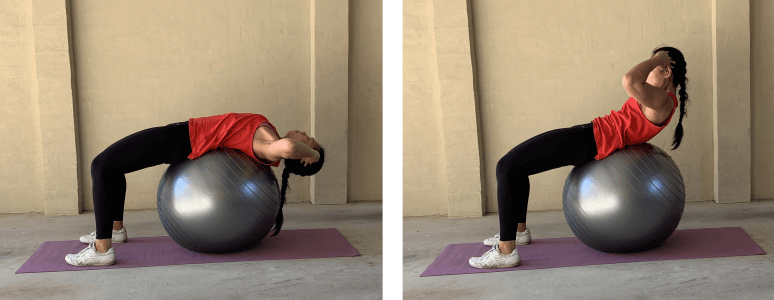
Better control
Using the ball for core or strength training forces you to move more slowly and deliberately to avoid losing balance. This kind of controlled movement is excellent for developing precision in your training and building the smaller stabilising muscles around your joints.
Better balance
Ball training develops strength and balance simultaneously. Better balance improves stability, reduces fall risk as you age and helps athletes execute complex movements in their sport.
Works the body as a unit
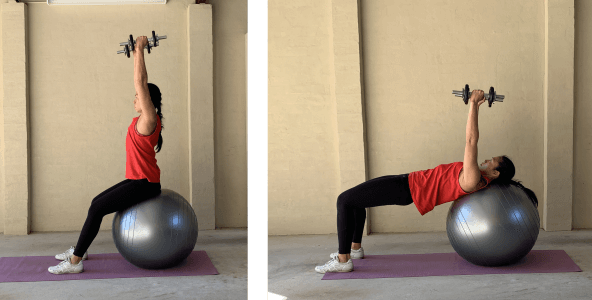
When performing an exercise on the ball, you maintain your balance and centre of gravity throughout because the unstable surface requires your whole body to participate. During a seated dumbbell shoulder press on the ball, your legs are engaged. During a plank knee tuck with your feet in the ball, your shoulders and arms are fully involved. It's a genuine full-body training tool.
How to choose the right exercise ball size
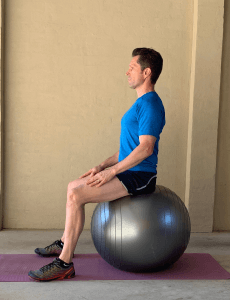
Get a good quality anti-burst ball with a soft non-slip surface. These balls deflate slowly if punctured rather than bursting suddenly. Make sure your ball is well inflated so there isn't much compression when you press on it firmly.
For seated exercises, the general rule is to sit on top of the ball with your feet flat on the floor, your hips slightly higher than your knees and your natural lower back curve maintained. This position forces your core to work to maintain an upright posture.
The main sizes are:
- Small: 55cm, suitable for people under 165cm tall
- Medium: 65cm, suitable for people between 165 and 185cm
- Large: 75cm, suitable for people over 185cm
Health should feel like your best life, not a break from it.
Marco ☕
 |
About Me I'm Marco Asnicar, personal trainer, nutrition coach and founder of Vitality Marco. I didn't discover the Mediterranean method. I grew up living it, shaped by Italian roots, real food and movement as a natural part of daily life. I coach men and women aged 35 to 55 to do the same. No restriction. No fads. No giving up the life you love. Just a way of eating and living that genuinely feels good and gets better every year. Want to know more about my story and approach? Read my full About Me page → |