Exercise Mat
The Foundation of Every Floor-Based Workout
An exercise mat is an essential part of any home gym, especially if you plan to do ab work, stretching, ground-based exercises or any training that puts you on the floor. It provides cushioning and support, protects your flooring from equipment and gives you a defined, non-slip surface to work on.
A quality exercise mat should be non-slip, durable and comfortable enough to train on consistently. Here's a guide to the different types available and what I use.
Types of exercise mat
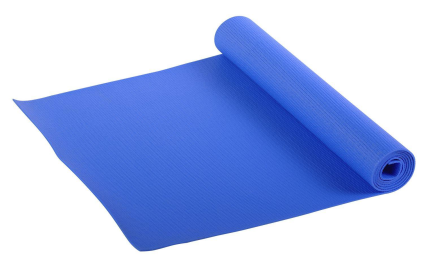
Standard exercise mat
The mat I use for most ground exercises. Standard size is 180cm long, 60cm wide and about 1cm thick. That's two to three times the thickness of a standard yoga mat and considerably more comfortable for floor exercises on a hard surface. They provide enough cushioning to protect you and your joints while still offering a firm, stable surface. They roll up easily for storage. This is my everyday recommendation for most home gym users.
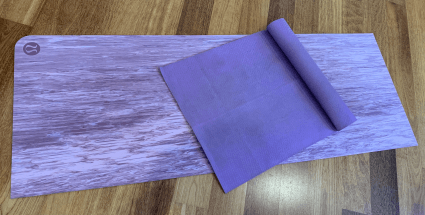
Yoga mat
Generally the same dimensions as a standard exercise mat but thinner at 5 to 8mm. Designed with a non-slip surface primarily for yoga practice. Useful if you incorporate yoga or lighter mobility work into your routine. Not ideal as a primary exercise mat for high-impact work due to the limited cushioning.
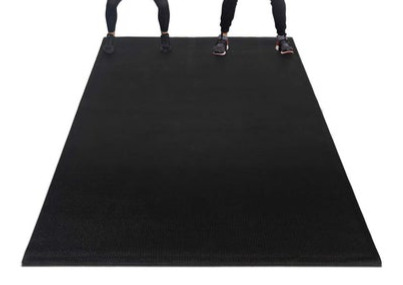
Cardio or extra-large mat
Useful if you find standard mats too narrow for your exercises or if you want a larger defined workout space. These mats come in various lengths and widths and some are made thicker and heavier for tumbling or more vigorous movement.
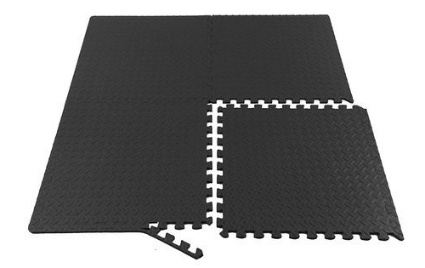
Interlocking mats
Also called puzzle exercise mats. Square tiles of around one metre by one metre that connect together. They don't separate or slide around during training and you can configure them in any shape or size to cover exactly the area you need. A practical and affordable option for defining a workout zone within a larger space.
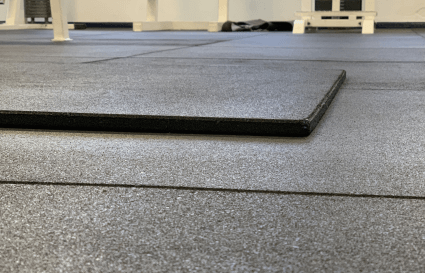
Home gym floor mats
Also called rubber flooring tiles, these are made from recycled rubber used in commercial gym flooring. Dense, heavy, durable and extremely effective at absorbing impact when exercising or dropping weights. They can be used to tile an entire gym floor or to stabilise the area beneath specific equipment. This is what we use in our garage gym and they've been an excellent long-term investment.
How to choose the right mat
The right mat depends on the type of training you're doing and the surface it will sit on.
- For floor exercises and stretching on hard surfaces: standard exercise mat or interlocking mats
- For yoga and light mobility work: yoga mat
- For an entire home gym floor: rubber flooring tiles
- For HIIT or high-impact movement: thicker cardio mat or rubber flooring tiles
- For a portable option when travelling: standard exercise mat or yoga mat
Whatever you choose, get a non-slip surface, adequate thickness for the work you're doing and a size that gives you enough room to move freely in every direction.
Health should feel like your best life, not a break from it.
Marco ☕
 |
About Me I'm Marco Asnicar, personal trainer, nutrition coach and founder of Vitality Marco. I didn't discover the Mediterranean method. I grew up living it, shaped by Italian roots, real food and movement as a natural part of daily life. I coach men and women aged 35 to 55 to do the same. No restriction. No fads. No giving up the life you love. Just a way of eating and living that genuinely feels good and gets better every year. Want to know more about my story and approach? Read my full About Me page → |