Resistance Bands
Inexpensive, Portable and More Effective Than Most People Realise
Resistance bands and tubes are a great alternative to weights, especially if you're new to resistance training or want to add variety to your workouts. They can also be used for stretching, mobility work and rehabilitation exercises.
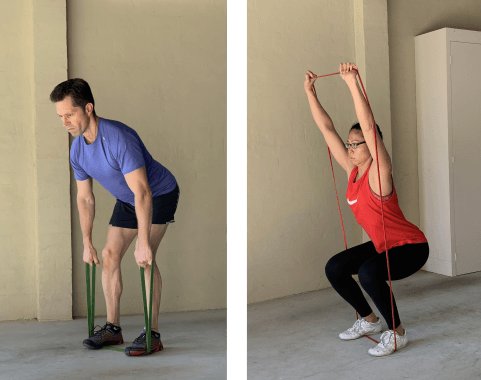
They're inexpensive, user-friendly and convenient. Particularly useful when travelling since they weigh almost nothing and take up no meaningful space in a bag. These multi-purpose tools come in different resistance levels depending on their length, width and thickness: light, medium, heavy and extra heavy. Most are colour-coded to indicate their resistance level. Bands and tubes can also be stacked to provide progressive resistance as you get stronger.
What makes resistance bands worth having?
Constant tension throughout the movement
When performing an exercise with a band or tube, there is constant tension through both the lifting and lowering phases of the movement. This forces you to perform each exercise with better control and a full range of motion.
Some people neglect the lowering phase when using weights, letting gravity take over. A band doesn't allow that. The eccentric phase is just as loaded as the concentric phase. This builds strength and muscle endurance more thoroughly as a result.
Variable resistance
The more you stretch the band, the harder the exercise becomes. A dumbbell provides the same resistance throughout the entire movement. A band increases resistance as you approach full extension, which is called accommodating resistance and it's genuinely useful for training strength at different points through the range of motion.
Resistance in multiple directions
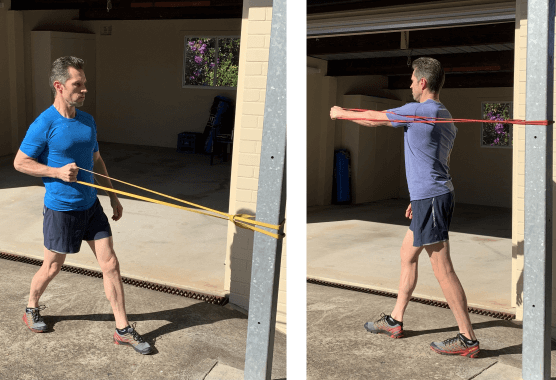
Free weights work in one direction: vertically against gravity. Bands and tubes provide resistance in any direction you choose. You can perform a chest press horizontally while standing, work rotational movements, train lateral patterns and load exercises that weights simply can't load effectively.
Builds the small supporting muscles
Bands are perfect for training the smaller stabiliser muscles that support the larger ones and keep your joints healthy. A band pull-apart, for example, strengthens the smaller muscles at the back of the shoulders that are critical for joint health and posture. These muscles are difficult to train effectively with weights alone.
Types of resistance bands
Flat therapy bands
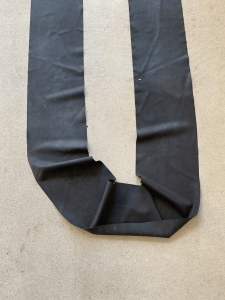
The thinner, broader flat variety like the TheraBand. Comfortable enough to wrap directly around your hands or body. Best for rehabilitation exercises, stretching and light resistance training. Excellent for warm-up movements and joint mobility work.
Closed-loop resistance bands
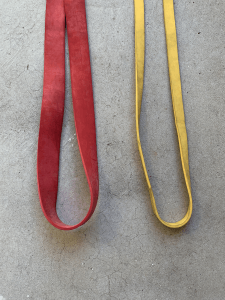
The thicker, narrower looped bands used for resistance training. These can be combined with other equipment to increase the difficulty of an exercise or to assist with movements like pull-ups, particularly during the eccentric lowering phase. More versatile than flat bands for strength training purposes.
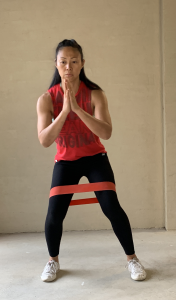
Mini bands
The smaller, shorter closed-loop bands that increase strength, stability and limb alignment. Excellent for lateral movement exercises, glute activation work, hip strength exercises and rehabilitation. A staple of most warm-up routines for lower body training.
Resistance tubes
Resistance tubes are circular rubber tubes with handles. The resistance depends on the thickness of the tube: the thicker the tube, the more resistance. The handles make them more comfortable for pressing and rowing movements and allow you to mimic cable machine exercises without the machine.
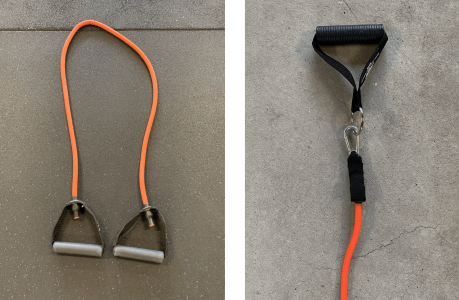
There are two main varieties. One has permanently attached handles. The other has a carabiner-style clip to attach the handle, which means the tubes can easily be stacked together to increase resistance as your strength improves. Most tube sets also come with additional attachments including an ankle strap and door anchor, which significantly expand the range of exercises available.
Which is better: the band or the tube?
The honest answer is: it depends on what you're using them for, which exercises you're doing and how experienced you are with resistance training.
If you're a beginner or have never used a resistance band or tube before, I recommend getting a combination of three different resistance levels: light, medium and heavy. Some exercises naturally require more resistance than others and having that range from the start means you're never under or over loaded for a particular movement.
Both tubes and longer closed-loop bands are perfectly suitable when starting out. Tubes are slightly more comfortable to use because of the handles and additional attachments. That said, I personally prefer bands because of their greater versatility and the way they combine effortlessly with other equipment. A band can wrap around a barbell, attach to a rack, loop around your legs or assist a pull-up. A tube with handles is more limited in how it can be used.
My recommendation: start with a set of resistance tubes and a set of closed-loop bands. Between the two you'll have everything you need for a complete and varied resistance band training programme.
Health should feel like your best life, not a break from it.
Marco ☕
 |
About Me I'm Marco Asnicar, personal trainer, nutrition coach and founder of Vitality Marco. I didn't discover the Mediterranean method. I grew up living it, shaped by Italian roots, real food and movement as a natural part of daily life. I coach men and women aged 35 to 55 to do the same. No restriction. No fads. No giving up the life you love. Just a way of eating and living that genuinely feels good and gets better every year. Want to know more about my story and approach? Read my full About Me page → |