Volume Eating for Weight Loss
Eat More Food. Weigh Less. Here's Exactly How I Do It.
Volume eating for weight loss is a strategy I genuinely love, especially when I want to get to a low body fat. It's also one of the first strategies I introduce to clients who struggle with hunger while trying to lose weight. The concept is straightforward: eat large quantities of low-calorie, high-volume foods to stay full while maintaining a calorie deficit.
When you fill your plate with foods that are high in water content, fibre and nutrients but low in energy density, you can eat genuinely satisfying meals without consuming the calories that prevent fat loss.
What is volume eating?
Volume eating is a dietary approach that focuses on the energy density of foods rather than simply the amount you eat. Foods with low energy density contain fewer calories per gram, which means you can eat more of them without consuming excess calories.
Think of it this way: 100 calories of chips takes about five to ten chips. 100 calories of cucumber fills a bowl. Both are 100 calories. One leaves you hungry. The other fills you up. That's the principle.
How to use volume eating for weight loss
Choose low-calorie, high-volume foods
Opt for foods that are high in water content, fibre and nutrients but low in calories. Fruits, vegetables, whole grains, lean proteins and legumes are the foundation. These foods take up a lot of space in your stomach relative to the calories they provide.
Prioritise non-starchy vegetables
Broccoli, spinach, capsicum, zucchini, cucumber, celery, leafy greens. These are extremely low in calories and high in fibre. I fill at least half my plate with vegetables at every meal when I'm in fat loss mode.
Increase fibre intake
Fibre-rich foods add bulk to your meals, promote satiety and reduce overall calorie intake. Whole grains, legumes and certain fruits and vegetables are your best sources.
Start with soups and salads
Beginning a meal with a broth-based soup or a large salad fills you up with very few calories, making it easier to control portions in the main course.
Use smaller plates and bowls
Using smaller dinnerware creates the visual impression of a larger portion. The psychology genuinely works.
Drink plenty of water
Staying hydrated helps curb hunger and prevent overeating. Drinking water before meals also increases satiety.
My go-to volume eating meals
The mega salad
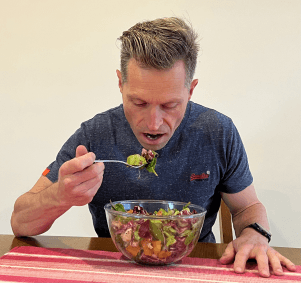
A large salad is my first choice when using volume eating. I'll use a mixing bowl and fill it with up to 20 different ingredients including leafy greens, colourful vegetables, legumes, seeds, grains and a source of lean protein like grilled chicken or fish. Low-calorie dressing or vinegar adds flavour without significant calories. It looks enormous and is genuinely filling.
Egg white frittata
A mainly egg white frittata is my other go-to. I'll use one whole egg with the rest being egg whites, packed with colourful vegetables like mushrooms, zucchini, capsicum, onions and fresh herbs. High in protein, very low in calories and genuinely satisfying.
Vegetable stir-fry
A stir-fry made with a variety of colourful vegetables, lean protein like prawns, chicken, tofu or tempeh and a small amount of sauce. Serve over cauliflower rice or zucchini noodles to keep the calorie count low.
Vegetable soup
A vegetable-based soup like minestrone or a mixed vegetable soup can be very filling while being very low in calories. Adding beans or lentils increases protein and fibre content significantly.
Sweet potato toasty
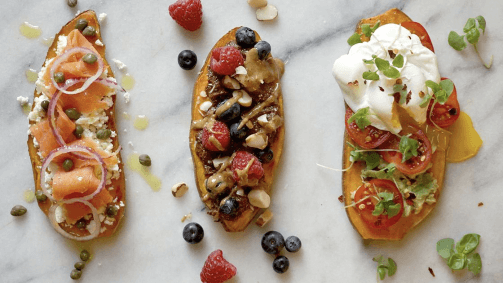
Here's a unique (and tasty) way to eat more veggies: Sweet potato toasty. Sweet potato slices serve as the toast base, roasted in the oven with a little olive oil. The toasted slices can be stored in the fridge for up to four days and reheated in a toaster.
Ingredients
- 1 large sweet potato, cut into roughly 6 mm (¼") lengthwise slices (will yield about 4-6 slices)
- 2 tsp olive oil
Method
- Preheat the oven to 180°C (360°F), and line a baking tray with parchment paper.
- Place potato slices in a bowl and toss with olive oil.
- Arrange slices on a baking tray, being careful not to crowd them.
- Place in the oven and bake for 15 minutes. Remove from the oven, flip the slices, and bake for 10 more minutes.
- Once the "toasts" are baked, top them as you choose.
Some topping ideas
- Ricotta & smoked salmon (Tip: Add thinly sliced onions and a sprinkling of capers for some textural and flavour contrast.)
- Smashed avocado & poached egg (Tip: Chili flakes and fresh microgreens turn this into a real mouth party.)
- Nut butter & berries (Tip: Ricotta or cottage cheese can be used instead of nut butter.)
Feel free to customise with you favourite ingredients.
Buddha bowl
A bowl filled with a variety of vegetables, whole grains like quinoa or brown rice and a lean protein source. Top with a low-calorie dressing or sauce. Excellent when eating out.
Volume eating is one tool in the weight loss toolkit and works best alongside a balanced diet, regular physical activity and other healthy lifestyle habits. But as a strategy for managing hunger in a calorie deficit, it's genuinely one of the best I know.
How to suppress hunger when losing weight →
Health should feel like your best life, not a break from it.
Marco ☕
 |
About Me I'm Marco Asnicar, personal trainer, nutrition coach and founder of Vitality Marco. I didn't discover the Mediterranean method. I grew up living it, shaped by Italian roots, real food and movement as a natural part of daily life. I coach men and women aged 35 to 55 to do the same. No restriction. No fads. No giving up the life you love. Just a way of eating and living that genuinely feels good and gets better every year. Want to know more about my story and approach? Read my full About Me page → |