Pull Up Bar
The Single Best Upper Body Strength Tool in My Home Gym
A pull up bar is one of the best exercise tools available for building upper body strength, particularly in the back, shoulders and arms, and for developing genuine core strength.
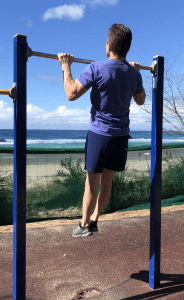
The pull-up itself is one of the most challenging and impressive feats of upper body strength: lifting your entire bodyweight off the ground until the top of your chest reaches the bar. I've noticed consistently that people who make the pull-up bar a central part of their training develop some of the best-defined backs and abs, along with excellent posture.
Pull up bar systems allow you to perform pull-ups, chin-ups and hanging leg raises. They can also have resistance bands attached for assisted pull-ups and various other exercises.
What to look for in a pull up bar
I generally prefer a pull up bar attached or secured to a solid structure. Here's what matters when choosing one.
Solid construction
Choose a strong, sturdy bar that can handle at least one and a half times your bodyweight. It should feel completely stable when in use with no flexing, bending or movement.
Multiple grip options
A bar with multiple grip positions lets you vary your hand placement from narrow neutral grip to wide overhand. Each grip targets your back, shoulders and arms from a slightly different angle for more complete development.
Comfortable grips
If you want to avoid developing calluses on your hands, choose a bar with smooth or rubber-coated handgrips rather than a steel knurled bar. Knurling is useful for heavy barbell work but unnecessary and uncomfortable for pull-ups.
Mounting position
Wall-mounted systems can work but they often position you too close to the wall. Because I like to straighten my legs during pull-ups, I find my feet constantly hit the wall with a standard wall-mounted bar. If a wall-mounted system is your only option, choose one with the bar at least 60cm away from the wall so you can face away from it and move freely.
My preference is a bar attached to two solid posts like you'd find on park exercise equipment, or a bar fixed to the top of a power rack.
Types of pull up bars
Straight bar
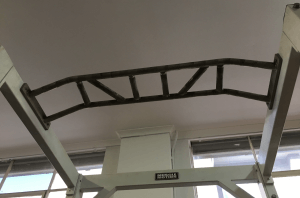
The most popular. A simple horizontal bar securely attached to a solid structure. Reliable, durable and straightforward.
Multi-grip bar
Provides multiple grip options from narrow neutral grip to angled grip to wide overhand. The various grip options allow you to work your back, shoulders and arms at different angles. We have a multi-grip bar fixed to the top of our power rack and I use it in almost every upper body session.
Types of pull up bar systems
Doorway pull up bar
Portable and affordable systems that require no permanent installation. I've tried a few of these and they can work well provided:
- You choose a solid construction system with a substantial weight capacity
- You have an architrave and enough room around your door frame to accommodate the device
- The construction of your door frame is strong enough to handle the load during pull-ups
- You choose a multi-grip bar for workout variety
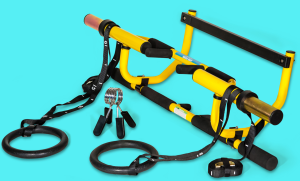
One that caught my attention is the Mega Bar by Gym Supreme. It's robust with a 136kg weight capacity and is genuinely multi-functional. It can be used on your door frame for pull-ups, has attachment points for gymnastic rings and suspension straps, and can even be converted to a barbell. Worth a look.
Another option is the telescoping door frame pull up bar that extends to fit within the jambs of a standard doorway without requiring any hardware. I'd still recommend adding brackets at each end to ensure it's fully secured under load.
Wall or ceiling mounted system
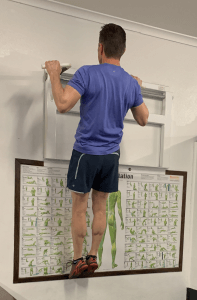
The advantage of wall and ceiling mounted systems is that they take up minimal floor space. Remember to choose a wall-mounted bar that extends at least 60cm from the wall for adequate clearance.
Some ceiling systems use brackets anchored to ceiling joists or beams, which gives you plenty of clearance around the bar. Just check that your ceiling height gives you enough vertical room to perform a full range pull-up. Some systems allow the bar height to be adjusted on the brackets to accommodate different ceiling heights.
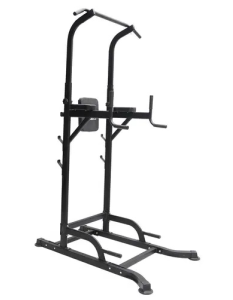
Free-standing system
If you rent or don't want to drill into walls, a free-standing system avoids any permanent installation. Many also come with dip bar attachments which adds significant exercise variety. The drawback is that free-standing structures can move slightly during pull-ups and take up more floor space than other options. Choose one with a very wide, heavy base to minimise movement.
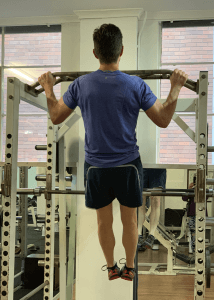
Power rack
Most power racks come with a pull up bar or multi-grip bar attached at the top. This is the most solid and stable option available for home gym pull-ups. The rack's weight and construction means zero movement during even the most demanding sets. If you already have or plan to get a power rack, the pull up bar at the top is one of its most valuable features.
Improvised pull up systems
Sometimes you work with what you have. Improvised pull up systems include things like a solid tree branch or the underside of a staircase.
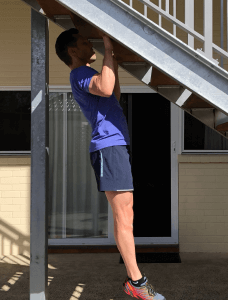
Safety is the absolute priority with these options. They are not as secure as a purpose-built steel bar and should be approached with caution.
I remember as a kid using a tree branch to attempt pull-ups. If you go down this path, make sure you're using a solid, mature tree with a genuinely sturdy branch and grip close to the trunk where the branch is thickest and strongest.
I occasionally use the underside of my outdoor steel staircase to challenge my grip on the wooden steps. I do this at my own risk and wouldn't advise anyone to try it unless they're experienced at pull-ups and confident in the structure they're using.
A safer improvised option is gymnastic rings hung from a solid overhead structure. Rings introduce instability which makes pull-ups harder, but they're purpose-built for the load and significantly safer than a tree branch or a staircase. They also open up a wide range of additional bodyweight exercises.
Health should feel like your best life, not a break from it.
Marco ☕
 |
About Me I'm Marco Asnicar, personal trainer, nutrition coach and founder of Vitality Marco. I didn't discover the Mediterranean method. I grew up living it, shaped by Italian roots, real food and movement as a natural part of daily life. I coach men and women aged 35 to 55 to do the same. No restriction. No fads. No giving up the life you love. Just a way of eating and living that genuinely feels good and gets better every year. Want to know more about my story and approach? Read my full About Me page → |