Power Rack
The Centrepiece of a Serious Home Gym
I'm a huge fan of having a power rack. Its multi-functional versatility, safety features and ability to support a wide range of attachments make it one of the best investments you can make in your home gym.
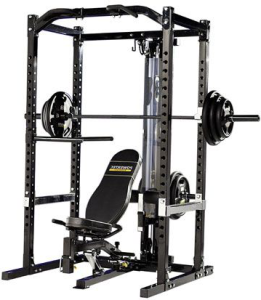
If you have the space and want to train safely and effectively with heavy barbell exercises, a power rack is an excellent long-term investment. A power rack, sometimes called a power cage, is a fully enclosed cage with four uprights, horizontal bracing and adjustable safety bars. The uprights have a series of holes from top to bottom for safety bars and J-hooks that hold the barbell at whatever height you need.
As you get stronger, your other equipment may no longer challenge your muscles adequately. A goblet squat, for example, might challenge your upper body grip before it challenges your legs. With a power rack and a barbell, you can load up for heavy back squats and train your legs properly and safely.
Safety features
Training at home without a spotter is one of the genuine limitations of home gym training. Power racks solve this completely. The adjustable safety bars act as your spotter. Set them correctly and if you reach failure during a back squat or bench press, you simply lower the bar onto the safety bars. You get out safely and no one gets hurt. This allows you to push harder with genuine confidence, which is the whole point of having a power rack.
What to look for in a power rack
Solid construction
A strong, sturdy, heavy-duty rack will last a lifetime. I like a heavy rack of around 100kg with a deep frame and wide base. This provides a stable platform that doesn't shake or move when you're doing pull-ups or heavy squats.
Adjustable hole spacing
Look for a rack where the hole adjustments are not too far apart. Good racks don't exceed 50mm spacing and run from top to bottom. This allows you to customise the J-hooks and safety bars to exactly the right position. Numbered holes make adjustments fast and repeatable.
Weight capacity
The rack should handle at least 400 to 500kg on the J-hooks and safety bars. Not because you'll lift that much, but because that margin means the rack is built with genuine structural integrity. You want a rack that's strong enough to handle significantly more than you'll ever ask of it.
Quality safety bars
Secure, easy to adjust safety bars that stay where you put them. Test them before buying if possible.
Attachment options
A good power rack accepts a range of attachments: high and low pulley cable systems for cable exercises, dip bars, battle rope anchors, band pegs for resistance bands, spotter arms, landmine attachments and plate storage. These attachments significantly expand the range of exercises available without requiring more floor space.
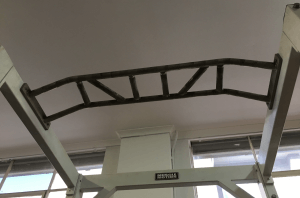
Multi-grip pull up bar
Make sure the rack includes a multi-grip pull up bar at the top. This is one of the best additions a power rack can have. Pull-ups, chin-ups, hanging leg raises and various grip variations all become available. Our rack has a multi-grip bar and I use it in almost every training session.
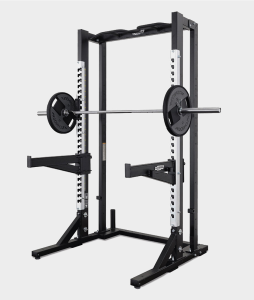
Full rack or half rack?
I prefer a full power rack rather than a half-rack because of the added safety features. You can perform a heavy lift, and rest assured if you lose control of the bar, it will fall within the cage on the safety bars and not on top of you.
That said, if you don’t have space at home for a full rack, then the half rack can still be a good choice. Just make sure to choose one that has adjustable safety bars or arms.
Health should feel like your best life, not a break from it.
Marco ☕
 |
About Me I'm Marco Asnicar, personal trainer, nutrition coach and founder of Vitality Marco. I didn't discover the Mediterranean method. I grew up living it, shaped by Italian roots, real food and movement as a natural part of daily life. I coach men and women aged 35 to 55 to do the same. No restriction. No fads. No giving up the life you love. Just a way of eating and living that genuinely feels good and gets better every year. Want to know more about my story and approach? Read my full About Me page → |